
Republic of Bulgaria
State e-Government Agency
This is an archive website. To see the current website of the agency, visit https://e-gov.bg
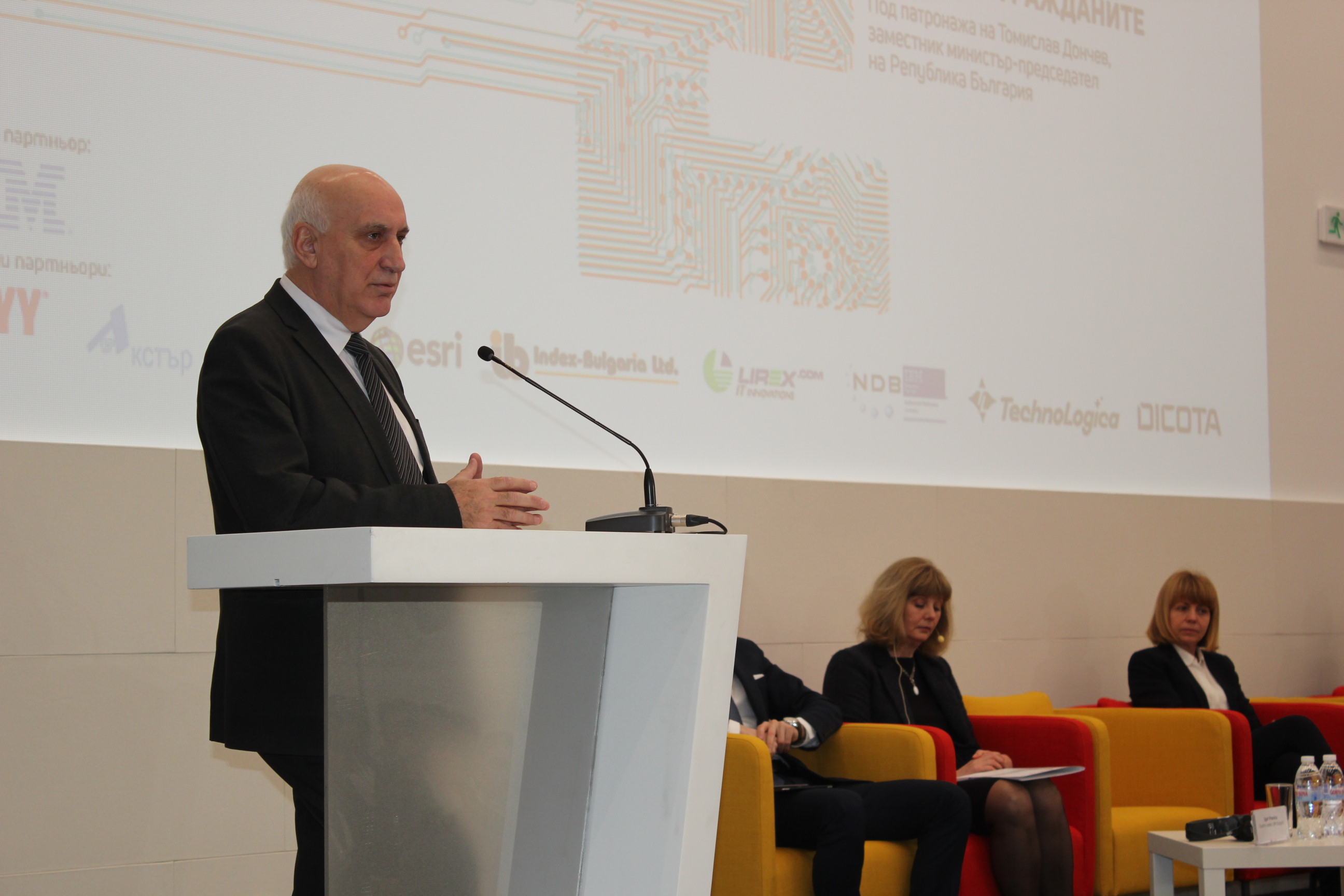
А. Temelkov: Whatever systems and technologies we deploy, e-government may not operate without citizens
The share of active users of Internet services hardly achieves 7%, and more than 80% of Bulgarian adults still prefer obtaining services ‘at desk‘.
Currently, mobile Internet users and fixed Internet users in Bulgaria are almost 5 million and about 1.7 million respectively (as per data from the Communications Regulation Commission). Nevertheless, the share of active users of Internet services hardly achieves 7%, and more than 80% of Bulgarian adults still prefer obtaining services ‘at desk‘ (as per data from Gallup International). All these figures demonstrate that whatever systems we develop and whatever technologies we deploy, if we fail to work with citizens and administrations, it would be hard to achieve good results in the e-government area. These were the words of Atanas Temelkov, Chairman of the State e-Government Agency (SEGA), before the participants in the 19th Annual e-Government Conference titled ‘E-government – services for citizens’.
The two-day forum organised by ICT Media, with the support of Sofia Municipality, the National Association of Municipalities in the Republic of Bulgaria and the State e-Government Agency, is held under the auspices of Tomislav Donchev, Deputy Prime Minister.
Atanas Temelkov reminded that in the first year of its operation, the SEGA identified all obstacles hindering the operating e-government, including the legal framework. The main challenge is the deployment of information and communication technologies and the management of deployed systems’ life-cycle, the SEGA Chairperson said. Therefore, the e-government architecture developed by the Agency provides for coordination mechanisms necessary for adequate planning, upgrade and deployment of information resources within the administration.
The future e-government architecture also provides for implementing the role of Chief Information Officer (CIO) in public administrations who will have the leadership functions in planning, coordinating and developing information resources, Mr Atanas Temelkov added. The Chief Information Officer functions will not cease the functions of current IT managers in institutions concerned, but will refer to ‘the political and organisational powers to manage administrations’ business processes themselves,’ Mr Temelkov explained. Partially or wholly key issues of the e-government architectural framework are expected that to be made public in April.
State e-Government Agency
Bulgaria, 1000 Sofia, 6 "Gen. Yosif V. Gurko" Street"
Tel. +359 (2) 949 20 40, +359 (2) 949 21 15, Fax: +359 (2) 949 21 58